Real cancer drivers walkthrough
Source:vignettes/v02_real_cancer_drivers.Rmd
v02_real_cancer_drivers.RmdReal cancer drivers walkthrough
This vignette uses the bundled
dataset_real_cancer_drivers_4 dataset to illustrate a real
biological analysis: how do four canonical cancer driver catalogs
overlap?
The four sources are:
- Vogelstein — the 138-gene catalog from Vogelstein et al. (Science 2013), often cited as the “core” oncogene set.
- COSMIC_CGC — the COSMIC Cancer Gene Census (Sondka et al. 2018), a curated list of genes causally implicated in cancer.
- OncoKB — the MSK precision-oncology knowledge base annotation level ≥ “Oncogenic” (Chakravarty et al. 2017).
- IntOGen — pan-cancer driver mutations from the IntOGen pipeline (Martínez-Jiménez et al. 2020).
library(vennDiagramLab)
ds <- load_sample("dataset_real_cancer_drivers_4")
ds@set_names
#> [1] "Vogelstein" "COSMIC_CGC" "OncoKB"     "IntOGen"
Set sizes
sapply(ds@items, length)
#> Vogelstein COSMIC_CGC     OncoKB    IntOGen
#>        138        581       1231        633
The lists are very different in size — Vogelstein is the smallest curated set; OncoKB is the most permissive at this annotation tier.
Universe
The dataset was built from a 20,000-gene background
(universe_size):
ds@universe_size
#> [1] 20000
This is the population N used in the hypergeometric
over-representation tests (see
vignette("v05_statistics_deep_dive")).
Set sizes (inclusive) and intersection layout
result@set_sizes
#> Vogelstein COSMIC_CGC     OncoKB    IntOGen
#>        138        581       1231        633
A summary at a glance
broom::glance() returns a one-row tibble with the
headline numbers:
broom::glance(result)
#> # A tibble: 1 × 8
#>   n_sets n_regions n_items universe_size model      is_approximate n_significant
#>    <int>     <int>   <int>         <int> <chr>      <lgl>                  <int>
#> 1      4        15   20000         20000 venn-4-set FALSE                      6
#> # ℹ 1 more variable: n_highly_significant <int>
Render the venn diagram
The default render uses the dataset’s set names as labels. To shorten them for the diagram, pass a per-letter override:
svg <- render_venn_svg(
    result,
    set_names = c(A = "Vogelstein", B = "COSMIC", C = "OncoKB", D = "IntOGen"),
    title = "Cancer driver overlap (4 sources)"
)
nchar(svg)
#> [1] 6475
(See vignette("v08_custom_styling_and_export") for color
overrides and post-render SVG manipulation.)
UpSet view
For 4+ sets, an UpSet plot is often easier to read than the Venn diagram — each intersection size is a bar, sorted by cardinality.
upset_plot <- render_upset(result, sort_by = "size")
upset_plot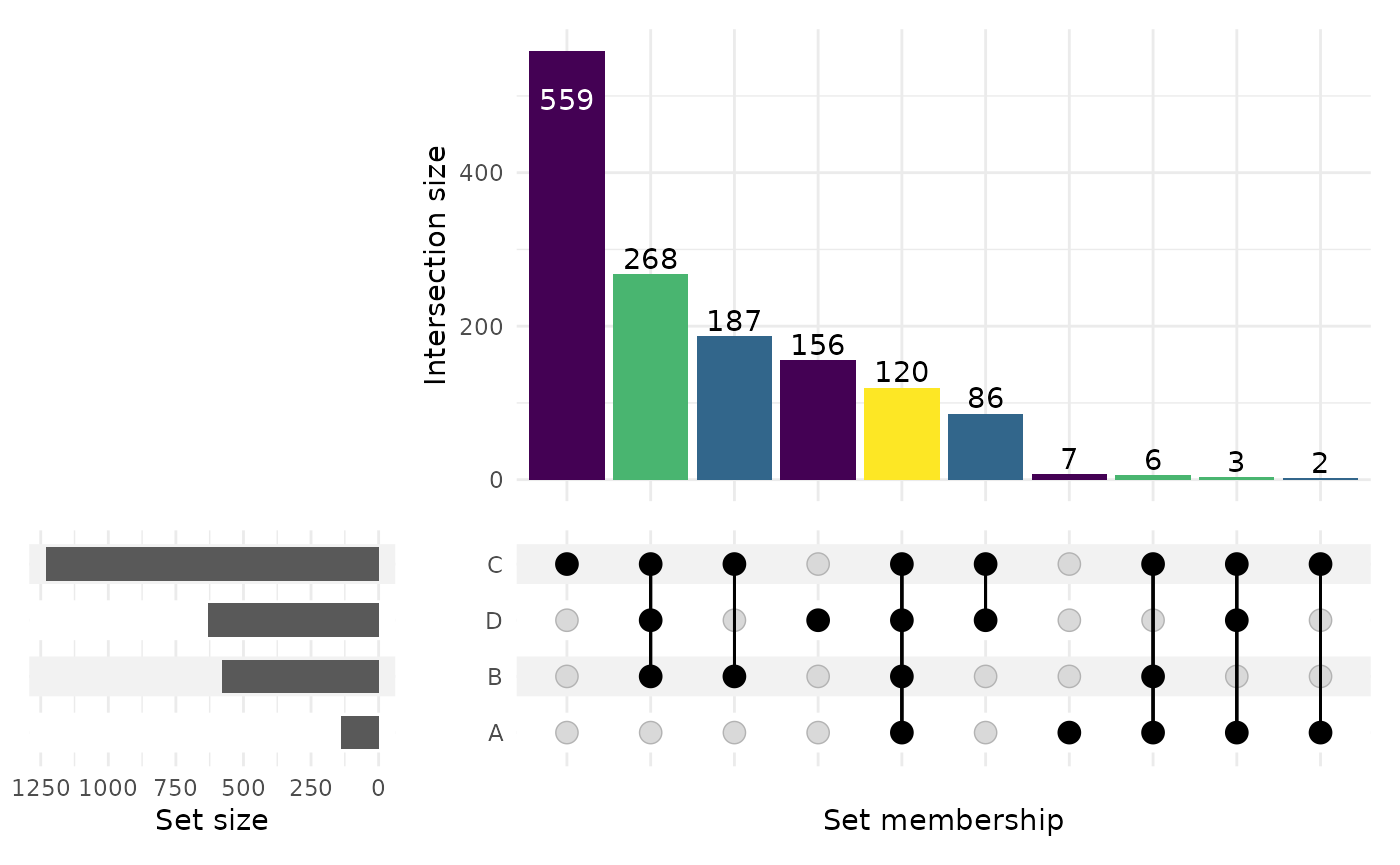
(The chunk above is gated on R >= 4.6 because the
CRAN release of ComplexUpset (1.3.3) is incompatible with
ggplot2 >= 4.0 on older R — see
?vennDiagramLab::render_upset for context.)
Top significant intersections
broom::tidy() returns one row per set pair, with all
five pairwise metrics plus the BH-FDR-adjusted hypergeometric
p-value:
top_pairs <- broom::tidy(result)
top_pairs[order(top_pairs$p_adjusted), c("set_a", "set_b", "intersection",
                                          "jaccard", "p_adjusted",
                                          "significant")]
#> # A tibble: 6 × 6
#>   set_a      set_b      intersection jaccard p_adjusted significant
#>   <chr>      <chr>             <int>   <dbl>      <dbl> <lgl>
#> 1 COSMIC_CGC OncoKB              581   0.472  0         TRUE
#> 2 COSMIC_CGC IntOGen             388   0.470  0         TRUE
#> 3 OncoKB     IntOGen             477   0.344  0         TRUE
#> 4 Vogelstein COSMIC_CGC          126   0.212  1.01e-183 TRUE
#> 5 Vogelstein IntOGen             123   0.190  5.54e-171 TRUE
#> 6 Vogelstein OncoKB              131   0.106  3.13e-151 TRUE
Every pair is significant at FDR < 0.05 (as expected — these catalogs are designed to overlap on biology).
Item-level annotation
broom::augment() returns one row per gene with
set-membership flags and the region label.
gene_table <- broom::augment(result)
head(gene_table)
#> # A tibble: 6 × 6
#>   item  Vogelstein COSMIC_CGC OncoKB IntOGen region_label
#>   <chr> <lgl>      <lgl>      <lgl>  <lgl>   <chr>
#> 1 A1CF  FALSE      FALSE      TRUE   FALSE   C
#> 2 AAMP  FALSE      FALSE      TRUE   FALSE   C
#> 3 ABCB1 FALSE      FALSE      TRUE   FALSE   C
#> 4 ABCC3 FALSE      FALSE      TRUE   FALSE   C
#> 5 ABCC4 FALSE      FALSE      FALSE  TRUE    D
#> 6 ABI1  FALSE      TRUE       TRUE   FALSE   BC
nrow(gene_table)        # total unique genes across all four sets
#> [1] 20000
table(gene_table$region_label)   # how many genes in each region
#>
#>           A   ABC  ABCD    AC   ACD    BC   BCD     C    CD     D
#> 18606     7     6   120     2     3   187   268   559    86   156
Save the region summary
to_region_summary_tsv(result, "cancer_drivers_regions.tsv")What’s next
-
vignette("v05_statistics_deep_dive")— interpret the Jaccard / Dice / hypergeometric numbers in detail. -
vignette("v07_pdf_reports")— turn this analysis into a multi-page PDF. -
vignette("v08_custom_styling_and_export")— customize colors, embed in a ggplot, export to PDF/PNG.